
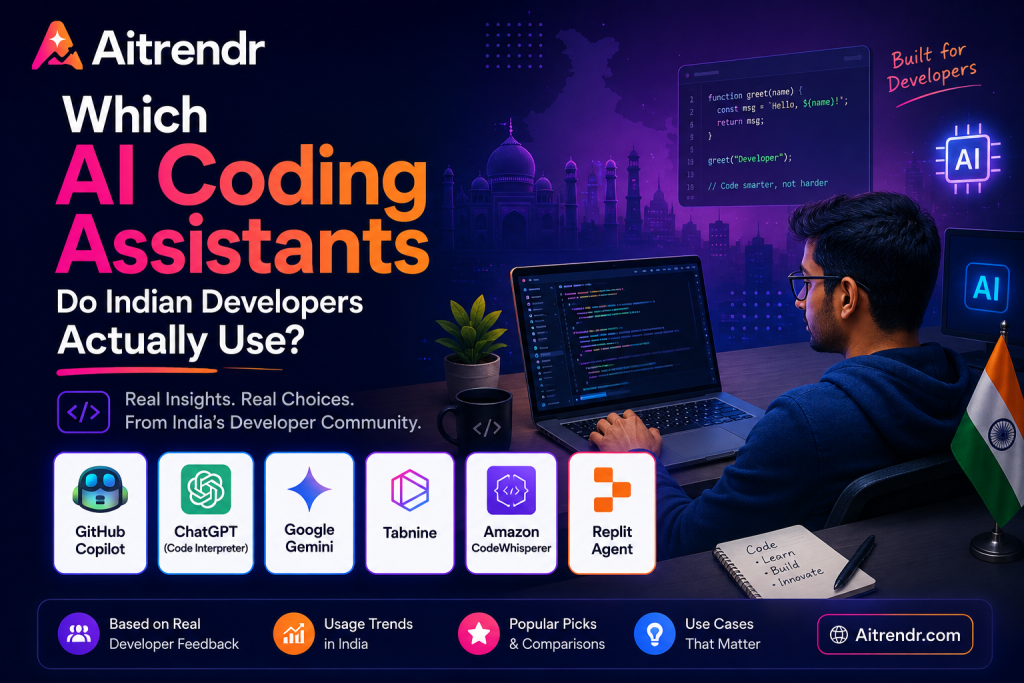
GitHub has more than 27 million developers in India. That is the second‑largest pool of programmers anywhere in the world. And nearly all of them now use some form of AI to help write code.
Not one or two tools. A whole stack of them. Some are free. Some cost money. Some come from big American companies. Others are built right here.
This is not a future prediction. This is Tuesday.
The one everybody knows
GitHub Copilot started the whole thing back in 2021. It sits inside Visual Studio Code and suggests entire lines or functions as you type. Today it has roughly 26 million users globally. In India, it grew faster than anywhere else.
Why? Two reasons.
First, Indian IT services firms like Infosys and Wipro pushed it hard. Infosys alone had more than 18,000 developers using Copilot to generate over 7 million lines of code. That is not a pilot project. That is production.
Second, new developers now expect it. According to GitHub’s Octoverse report, around 80% of new Indian developers use Copilot within their first week. It is not an optional extra. It is the default.
Copilot costs $10 per month. For many Indian developers, that is not cheap. But the free tier introduced in late 2024 opened the door for more people to try it.
The challenger that tripled in one year
Cursor is a different kind of tool. It is not just a plugin. It is a full IDE — a complete coding environment built around AI from the ground up.
India is now Cursor’s third‑largest market. Its user base here tripled over the past year to more than 3 million developers. And here is the kicker: Indian users run more agent requests per person than any other country.
Cursor noticed. So they launched a country‑specific plan in July 2026. ₹649 per month. UPI payments. Access to their own models but not OpenAI or Anthropic’s frontier ones. That is a deliberate trade‑off to keep the price down.
Cursor works well for refactoring and code completion. But it struggles with older, legacy codebases — the kind that still run many Indian enterprises. That is a real limitation.
The rising star
Windsurf focuses on context‑aware suggestions for large projects. It understands more of your codebase at once than Copilot does. Developers who work on big systems like it.
But Windsurf has limited language support. India’s developer ecosystem is polyglot — Java, Python, JavaScript, Go, Rust, C++, and more. A tool that only handles a few languages cannot win here.
Still, it is growing. Productivity is the hook.
The privacy‑first option
Tabnine takes a different approach. You can run its AI model entirely on your own machine. Zero data leaves your premises.
For Indian enterprises worried about data privacy — and 62% of Indian developers cite that as their primary concern — this matters. A lot.
Tabnine offers local deployment, on‑premise installation, and custom model training on private codebases. It costs $39 per user per month for the Pro plan. Enterprise pricing is custom.
Training courses for Tabnine now run in Bangalore and other Indian cities. That tells you something about adoption.
The one from AWS
Amazon CodeWhisperer (now part of Amazon Q Developer) is free for individual use. That is a big deal. It works inside VS Code, JetBrains IDEs, and AWS services.
It generates real‑time code suggestions and includes automated security scanning. For developers already working on AWS, it is an easy add‑on.
But CodeWhisperer does not get the same buzz as Copilot or Cursor. It feels like AWS’s answer to a question that developers did not really ask. Useful. Not exciting.
The OpenAI entry
OpenAI’s Codex platform has also found a footing in India. Adoption surged nearly 27 times since the start of 2026. India is now among Codex’s top five markets globally by user count.
Codex powers some of the other tools on this list. But OpenAI also offers it directly. Developers who want the underlying model without the wrapper go here.
The homegrown ones
India does not just consume AI coding tools. It builds them.
Rocket.new delivers production‑ready applications from natural language prompts. Emergent, Zoho, Composio, and NxtGen Cloud Technologies are also in the space.
Bud Ecosystem partnered with NxtGen to launch “M for Coding”. They position it as an affordable Indian alternative to Claude Code. With over six million developers in India, the market is large enough for local players.
Numbers worth remembering
Here is what the data says about Indian developers and AI coding tools:
- 100% of Indian tech leaders say their companies use AI‑assisted coding tools.
- 94% of developers use them daily.
- 84% expect usage to grow significantly in the next year.
- 43% say over a quarter of their code is now written with AI help.
- 92% agree that AI tools have made their work better.
- 67% say coding is faster.
- Indian developers save an average of 10 hours per week using these tools.
That last number is striking. Ten hours. More than a full workday. Every week.
Trust is complicated
Stack Overflow’s 2025 survey of over 49,000 developers across 177 countries found something interesting. Indian developers showed the highest level of trust in AI coding tools — 56% expressed some or significant trust.
But trust is not blind. 98% of Indian tech leaders said all AI‑generated code goes through peer review before production. 92% flagged risks around maintainability and security when AI code is deployed without human oversight.
Developers are not handing over their jobs. They are using AI as a junior assistant. One that needs checking.
The pressure problem
Not everything is smooth.
Some Indian companies have made AI coding tools mandatory. Developers report losing creative control and learning opportunities. One Reddit post described a company where managers expected features built in a single day and dismissed concerns with “You have Cursor right? Just use that”.
Some firms track AI usage metrics. Employees received warnings if their usage dropped for a few days. In one case, developers were asked to pay for Cursor subscriptions out of pocket and get reimbursed only if they could prove they used it.
That is not empowerment. That is enforcement.
The skills question
Indian developers spend an average of five hours per week learning about AI and emerging technologies. That is one hour more than their global peers.
But formal education is limited. Only 14% take structured courses or certifications. Most learning happens through YouTube tutorials and on‑the‑job experience.
Nearly half — 48% — plan to prioritise AI and machine learning upskilling in the next quarter. That is more than double the number planning to focus on DevOps or cloud.
Companies are noticing. 98% of tech leaders believe AI is transforming developer skillsets. All of them are comfortable with candidates using AI tools during technical interviews.
The enterprise Gap
Individual adoption is high. Organisational integration is not.
Globally, 64% of AI‑related initiatives are still in experimental or exploratory stages. Only 3% report full integration of AI tools in their regular delivery pipelines.
The barriers are real. Data privacy (62%), unclear internal policies (52%), and legacy IT systems (50%). These are not small problems.
What this adds up to
India has the second‑largest developer base on GitHub. It is adding more than a million developers every three months. By 2028, it will surpass the United States as the world’s largest developer community.
AI coding assistants are not a side note in that story. They are central to it.
Copilot is the incumbent. Cursor is the fast‑growing challenger. Windsurf is the productivity play. Tabnine is the privacy option. CodeWhisperer is the free AWS tool. Codex is the OpenAI backdoor. And the Indian startups are building their own alternatives.
Each one has strengths. Each one has weaknesses. Developers pick based on what they need, what they can afford, and what their company allows.
One thing is clear. Writing code by hand, line by line, is no longer the default. The question is not whether to use AI. The question is which one.
And for Indian developers, the answer is increasingly: more than one.